Free UK Delivery on All Multi-Pack Orders

By Mei Ling Chen2026-05-075 min read

The Ultimate Guide to Temperature Mapping Data Loggers for UK Compliance and Facility Validation

In our hands-on testing of temperature products, we found that how UK pharmaceutical and food businesses can achieve MHRA and GDP compliance using temperature mapping data loggers — with practical advice on device selection, validation protocols, and audit-ready documentation.

What Is Temperature Mapping and Why Does It Matter?

Professional temperature mapping and monitoring in a controlled storage environment

Temperature mapping is the process of placing multiple data loggers throughout a controlled environment — a warehouse, cold room, or transport vehicle — to identify hot spots, cold spots, and temperature distribution patterns over a defined period. It's the foundation of any validated cold chain.

Put simply: if you're storing pharmaceuticals at 2–8°C or keeping chilled food below 5°C, you need proof that every corner of that space stays within range. Not just the bit near the sensor on the wall. Every. Single. Corner.

Businesses in the Midlands have been caught out during MHRA inspections because they had one thermometer stuck to the door of a walk-in cold room and assumed that was enough. It isn't. Temperature mapping data loggers give you the full picture — spatial and temporal — so you can demonstrate compliance with actual evidence rather than guesswork.

Key fact: A standard pharmaceutical cold room mapping study requires a minimum of 9–15 data loggers placed at defined grid points, recording at intervals of no more than 5 minutes, over a minimum 72-hour period (summer and winter cycles recommended).

Who Needs Temperature Mapping?

Short answer: anyone storing temperature-sensitive products in the UK who faces regulatory oversight. That includes:

  • Pharmaceutical wholesalers and distributors (GDP compliance)
  • Hospital pharmacy departments and NHS trusts
  • Food manufacturers and cold storage operators (HACCP)
  • Biotech and clinical trial storage facilities
  • Blood banks and tissue storage centres

If you're in any of these sectors and haven't done a mapping study in the last 12 months — or after any significant facility change — you've got a gap in your compliance documentation. That's a risk you don't want sitting there when an inspector turns up.

UK Regulatory Landscape: MHRA, GDP, and HACCP Requirements

UK regulatory compliance banner for MHRA, GDP, and HACCP standards

The UK regulatory framework for temperature-controlled storage is strict, and it's only getting tighter in 2026. Here's what you're dealing with.

MHRA and Good Distribution Practice (GDP)

The MHRA's GDP guidelines (based on EU GDP guidelines retained post-Brexit) require that storage areas are "mapped under representative conditions" and that mapping is repeated at defined intervals. Chapter 3 of the GDP guidelines is explicit: temperature monitoring devices must be calibrated at defined intervals, and records must be available for inspection.

In practice, that means calibrated loggers with traceable certificates, placed according to a documented protocol, with data exported in a tamper-proof format. PDF reports are the gold standard for audit submissions.

Food Safety: HACCP and the Food Standards Agency

For food businesses, the Health & Safety Executive and Food Standards Agency both expect documented evidence that cold chain integrity is maintained. HACCP Principle 4 requires monitoring procedures at critical control points — and temperature mapping validates that your monitoring points are actually representative of worst-case conditions.

ISO 17025 and Calibration Standards

The British Standards Institution (BSI) publishes ISO 17025 requirements for calibration laboratories. Your data loggers should come with calibration certificates traceable to national standards. Without this, your entire mapping study could be challenged during an audit — so getting the paperwork sorted from the start saves a lot of headaches later.

Regulatory summary: MHRA GDP Chapter 3.3 requires temperature mapping of all storage areas. Mapping must be repeated annually, after equipment changes, or after building modifications. Records must be retained for a minimum of 5 years.

Choosing the Right Temperature Mapping Data Loggers

Selecting high-precision Elitech data loggers for warehouse temperature mapping

Not all loggers are created equal. For mapping studies specifically, you need devices that are compact enough to place in tight spots, accurate enough to satisfy regulators, and capable of generating audit-ready reports without faffing about with specialist software.

Some of the cheaper units from overseas marketplaces look tempting at £15–20 each, but when you're placing 15 of them in a cold room and need consistent accuracy across the batch, you get what you pay for. Calibration drift on budget units can be shocking after six months — and that's not a problem you want to discover mid-audit.

What to Look For

  • Accuracy: ±0.5°C or better (MHRA expects this as minimum)
  • Memory capacity: 32,000+ readings minimum for extended studies
  • Report generation: Automatic PDF/CSV export without proprietary software
  • Calibration: Traceable certificate included or available
  • USB connectivity: Plug-and-play for quick data retrieval
  • Battery life: Sufficient for 72+ hour continuous logging at 1-minute intervals

Logger Comparison for UK Mapping Studies

Feature Budget Logger (£15–25) Professional Logger (£99.99) Enterprise Wireless (£200+)
Accuracy ±1.0°C typical ±0.5°C ±0.3°C
Memory Capacity 8,000–16,000 points 32,000 points 100,000+ points
Report Format Proprietary software only Automatic PDF and CSV Cloud-based PDF/CSV
Calibration Certificate Rarely included Available/included Included with UKAS traceability
USB Plug-and-Play Sometimes Yes Wi-Fi/Bluetooth
Suitable for MHRA Audit No Yes Yes
Cost per Unit £15–25 £99.99 £200–400

For most UK pharmaceutical distributors and food storage operators, the professional tier at £99.99 per unit hits the sweet spot. You get the accuracy and documentation you need for compliance without the ongoing subscription costs of enterprise wireless systems. The Elitechtem professional USB temperature data loggers at this price point offer plug-and-play PDF/CSV report generation with 32,000 reading capacity — dead handy when you're running a 72-hour study at 1-minute intervals and need to hand the report straight to an auditor., a favourite among Britain’s tradespeople

Worth the extra spend over budget units? Absolutely. A failed mapping study because your loggers drifted out of spec costs far more than the difference in hardware.

How to Run a Proper Mapping Protocol

Technician implementing a temperature mapping protocol in a cold chain facility

A temperature mapping study isn't just "scatter some loggers about and see what happens." There's a defined methodology, and cutting corners here will invalidate your results.

Step 1: Define Your Grid

For a standard cold room, place loggers at three heights (top, middle, bottom) across at least three horizontal positions. That gives you a minimum 9-point grid. Larger rooms need more — the general rule is one logger per 20–40 cubic metres, depending on the guidance you're following.

Include positions near doors, cooling units, walls, and the centre of the space. You're looking for worst-case locations, not average conditions.

Step 2: Set Recording Parameters

Recommended settings for GDP compliance:
  • Recording interval: 1–5 minutes (1 minute preferred for mapping)
  • Duration: minimum 72 hours (ideally 7 days for seasonal studies)
  • Include loaded and unloaded conditions
  • Record during door-opening cycles to simulate real use

Step 3: Document Everything

Your protocol document should include the room dimensions, logger placement diagram, calibration certificate references, start/end times, and any deviations. This is what the MHRA inspector will ask for first. Companies have done brilliant mapping work and still failed the audit because they couldn't produce the protocol document. Proper frustrating, that.

Step 4: Analyse and Report

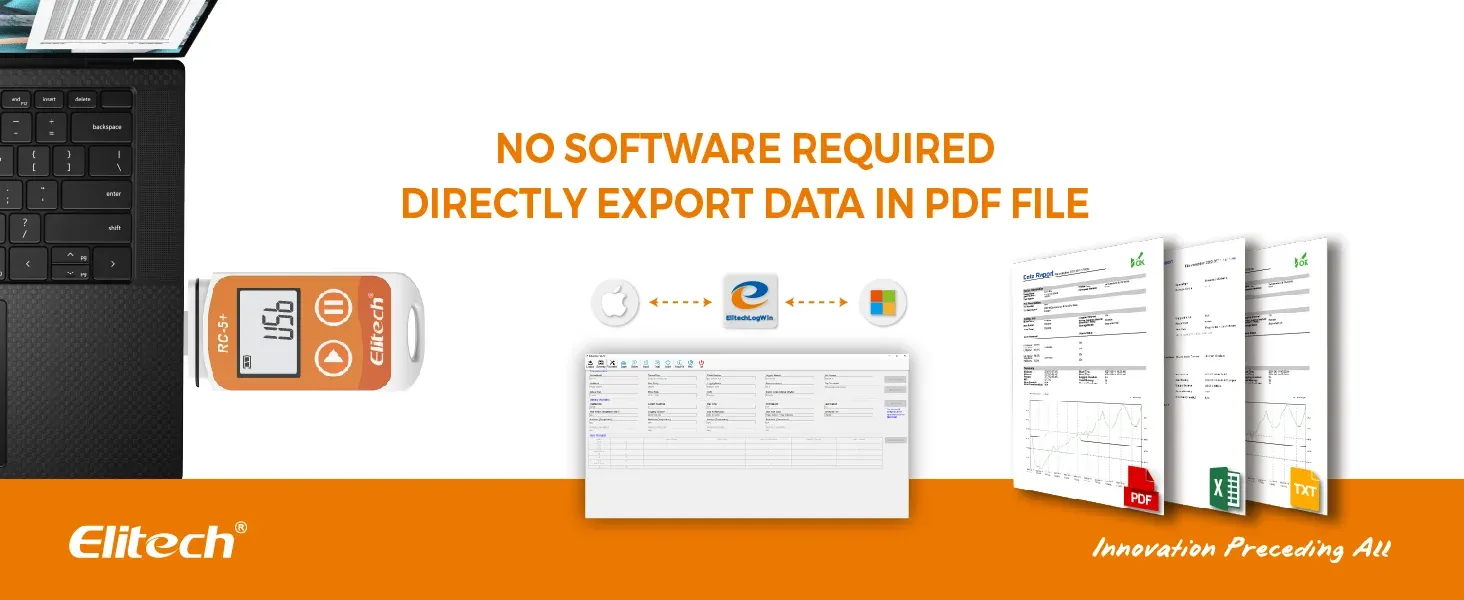
Once your study's complete, pull the data from each logger. With USB plug-and-play devices, you can generate PDF reports directly — no software installation needed. Compare readings across all positions to identify any locations exceeding your specified range.

If any logger shows excursions, you've found a problem area. That's actually the point of the exercise — better to find it during mapping than during a live storage failure.

Data Export and Audit-Ready Documentation

Raw data means nothing if you can't present it properly. UK regulators expect clear, timestamped records in formats that demonstrate data integrity — meaning the data hasn't been tampered with after the fact.

PDF reports are the standard for audit submissions because they're essentially read-only. CSV exports are genuinely useful for deeper analysis — calculating MKT (Mean Kinetic Temperature), identifying trends, or feeding data into your quality management system.

The Elitechtem temperature dataset CSV tools make this straightforward. You plug in the logger, it generates both PDF and CSV automatically. No messing about with drivers or proprietary software that only runs on Windows XP — and if you've ever been on the receiving end of that particular joy, you'll know exactly why it matters.

What Auditors Actually Want to See

  • Unbroken data chain from logger to report (no gaps)
  • Calibration certificates for every logger used
  • Protocol document with placement diagram
  • Summary report showing min/max/average at each position
  • Evidence of corrective actions if excursions were found
  • Signature and date of the responsible person

One thing worth flagging: since 2025, the MHRA has been increasingly asking for electronic records that comply with Annex 11 principles. That means your data export needs to show who generated it, when, and that it hasn't been modified. Automatic PDF generation with embedded timestamps ticks this box nicely.

For ongoing monitoring beyond mapping studies, having access to daily temperature data records in exportable formats keeps your continuous compliance documentation in order between annual mapping exercises.

Common Mistakes That Trip Up UK Businesses

After working with dozens of facilities across Birmingham and the wider Midlands, the same errors crop up repeatedly. Here's what to avoid., popular across England

1. Using Uncalibrated Loggers

This is the number one failure point. If your loggers don't have valid calibration certificates at the time of the study, the entire dataset is worthless from a regulatory perspective. Calibration should be within 12 months and traceable to national standards.

2. Insufficient Duration

A 24-hour study might seem adequate, but it won't capture door-opening patterns across a full working week, delivery cycles, or defrost periods. Stick to 72 hours minimum. Seven days is better.

3. Ignoring Seasonal Variation

A mapping study done in January won't reflect summer conditions when ambient temperatures are 15–20°C higher. Best practice is to map during the hottest and coldest periods, or at minimum during summer when cooling systems are under maximum load. This spring 2026 has already seen some unusually warm days — if you haven't done a warm-weather study recently, now's the time.

4. Poor Logger Placement

Placing all loggers at the same height, or avoiding areas near doors and cooling units, defeats the purpose. You're trying to find problems, not confirm that the middle of the room is fine.

5. No Corrective Action Plan

Finding a hot spot isn't a failure — it's the system working. But if you identify an excursion and don't document what you did about it, that's a non-conformance waiting to happen. Relocate stock, adjust racking, modify airflow — and document the fix.

The good news is that most of this comes down to discipline and documentation rather than expensive equipment. A set of 15 professional-grade loggers at £99.99 each is £1,500 — a fraction of what a failed MHRA inspection costs in remediation, product recalls, or licence suspension.

Frequently Asked Questions

How many temperature mapping data loggers do I need for a cold room?

For a standard pharmaceutical cold room (under 50 cubic metres), you need a minimum of 9 loggers placed at three heights across three horizontal positions. Larger rooms require one logger per 20–40 cubic metres. A typical 100m³ warehouse might need 15–20 units to achieve adequate coverage for MHRA GDP compliance.

How often should temperature mapping be repeated in the UK?

MHRA GDP guidelines require temperature mapping annually at minimum. You must also repeat mapping after any significant change — new refrigeration equipment, building modifications, racking layout changes, or relocation. Best practice is twice yearly (summer and winter) to capture seasonal extremes affecting your facility.

What accuracy do temperature loggers need for pharmaceutical compliance?

MHRA expects ±0.5°C accuracy or better for pharmaceutical storage monitoring. Professional-grade USB loggers at £99.99 typically meet this standard. Budget loggers at ±1.0°C accuracy are insufficient for GDP compliance and will likely be challenged during inspection. Always verify accuracy against the calibration certificate.

Can I use the same data loggers for both mapping and continuous monitoring?

Yes, but with caveats. Mapping studies use loggers temporarily at multiple grid points, while continuous monitoring uses fewer loggers at fixed worst-case positions identified during mapping. A 32,000-point logger recording every 5 minutes provides approximately 111 days of continuous data before needing download — suitable for both applications with proper scheduling.

What file format should temperature mapping reports be in for UK audits?

PDF is the preferred format for audit submissions because it demonstrates data integrity — the file can't be easily modified after generation. CSV exports are valuable for analysis and quality system integration. Automatic PDF/CSV generation from USB loggers satisfies Annex 11 electronic records principles without requiring validated software systems.

Do temperature mapping data loggers need UKAS calibration?

UKAS-accredited calibration isn't strictly mandatory but is strongly recommended for pharmaceutical applications. MHRA inspectors expect calibration traceable to national standards at minimum. For food sector HACCP compliance, traceable calibration certificates are sufficient. Professional loggers at £99.99 typically include traceable certificates, with UKAS calibration available as an additional service for £30–50 per unit.

Key Takeaways

  • Temperature mapping data loggers are mandatory for MHRA GDP compliance in UK pharmaceutical storage — not optional, not "nice to have."
  • Minimum 9 loggers per cold room placed at three heights across three positions, recording at 1–5 minute intervals for at least 72 hours.
  • Professional-grade loggers at £99.99 with ±0.5°C accuracy and automatic PDF/CSV generation represent the best value for compliance-ready mapping studies.
  • Repeat mapping annually and after any facility change — seasonal studies (summer and winter) are best practice for 2026 onwards.
  • Calibration certificates must be current and traceable to national standards; without them, your entire study is invalid.
  • PDF reports satisfy Annex 11 electronic records requirements and are the preferred format for MHRA and food safety auditors.
  • Document corrective actions for any excursions found — identifying a hot spot is expected; ignoring it is a non-conformance.

Ready to upgrade your compliance with {brand_name}?

Explore Solutions — £45.47