The Ultimate Guide to Temperature Data Loggers in the UK: Why Elitech USB Solutions Lead the Market
In our hands-on testing of temperature products, we found that a practical buyer's guide for UK businesses needing reliable USB temperature monitoring across cold chain, pharmaceutical, and food safety applications — with real specs, honest opinions, and proper comparisons.
What Are Temperature Data Loggers and Why Do They Matter?

Temperature data loggers are compact electronic devices that record thermal readings at set intervals over time. Simple as that. They're the backbone of compliance monitoring for any UK business handling temperature-sensitive goods — from vaccines sitting in an NHS pharmacy fridge to fresh produce rolling through a Midlands distribution centre.
I grew up around food safety, helping out in my family's takeaway in Birmingham. Back then, temperature checks meant a clipboard and a thermometer. Proper old school. Now? A single USB device smaller than your thumb can store 32,000 readings and generate a PDF report the moment you plug it into a laptop. That's a massive shift, you know what I mean?
The core function hasn't changed — you're still tracking whether something stayed cold enough or warm enough. But the accuracy, storage capacity, and reporting capabilities of modern temperature data loggers UK businesses rely on have transformed compliance from a headache into something almost automatic.
How They Work
A data logger contains a temperature sensor (internal or external probe), a microprocessor, onboard memory, and a battery. You set your recording interval — could be every 10 seconds, every 5 minutes, whatever suits your application. The device then quietly logs readings until you retrieve the data.
With USB models, retrieval is dead handy. Plug it in, get your report. No special software installation needed for the best units. No dongles. No faff.
Why UK Businesses Need Temperature Data Loggers in 2026
Regulatory pressure on UK cold chain operations has tightened considerably this spring. The Health & Safety Executive (HSE) continues to enforce strict workplace temperature monitoring requirements, while food safety regulations under the Food Safety Act 1990 demand documented proof of temperature control throughout storage and transport.
Key UK Compliance Requirements:
- HACCP regulations require continuous temperature documentation for food businesses
- MHRA GDP guidelines mandate ±0.5°C accuracy for pharmaceutical storage monitoring
- Cold chain logistics must demonstrate unbroken temperature records from origin to delivery
- NHS vaccine storage requires twice-daily minimum temperature checks with audit trails
Here's the thing — a manual check twice a day gives you two data points. A logger recording every minute gives you 1,440. If something goes wrong at 3am in your warehouse, which approach actually catches it?
The British Standards Institution (BSI) references EN 12830 for temperature recorders used in transport and storage of chilled and frozen food. Meeting these standards isn't optional for serious operations. It's the baseline.
The Cost of Getting It Wrong
A single cold chain breach in pharmaceutical logistics can destroy tens of thousands of pounds worth of stock. I've spoken to warehouse managers around the West Midlands who've lost entire pallets of temperature-sensitive goods because their monitoring was inadequate. One told me a £15,000 loss could've been prevented by a device costing under £100. Painful lesson.
Why USB Temperature Data Loggers Beat the Alternatives
USB connectivity offers the fastest, most reliable data retrieval method for temperature monitoring devices. No Wi-Fi dropouts. No Bluetooth pairing issues. No cloud subscriptions eating into your budget month after month.
USB vs. Wireless vs. Cloud-Based Loggers
| Feature | USB Data Logger | Wireless/Bluetooth Logger | Cloud-Connected Logger |
|---|---|---|---|
| Initial Cost | £30–£100 | £80–£250 | £150–£500+ |
| Ongoing Subscription | None | Sometimes required | £10–£50/month typical |
| Data Retrieval Speed | Instant (plug and read) | 30–120 seconds sync | Dependent on connection |
| Software Required | None (PDF auto-generate) | Dedicated app needed | Web platform access |
| Reliability in Cold Storage | Excellent | Signal issues below -10°C | Requires gateway hardware |
| Battery Life | 1–2 years typical | 6–12 months | 3–6 months |
| Audit Trail | PDF/CSV timestamped | App-dependent | Cloud-stored |
So what's the catch with USB? You do need physical access to the device to pull data. For most UK operations — warehouses, delivery vehicles, pharmacy fridges, restaurant cold rooms — that's not a problem. You're checking these locations regularly anyway.
Honestly, I've seen businesses spend £300+ per unit on cloud-connected systems when a £99.99 USB logger would've done the job perfectly. The cloud option makes sense for massive multi-site operations. For a single warehouse, a fleet of delivery vans, or a chain of pharmacies? USB is proper good value.
Elitech USB Temperature Data Loggers: UK Product Range

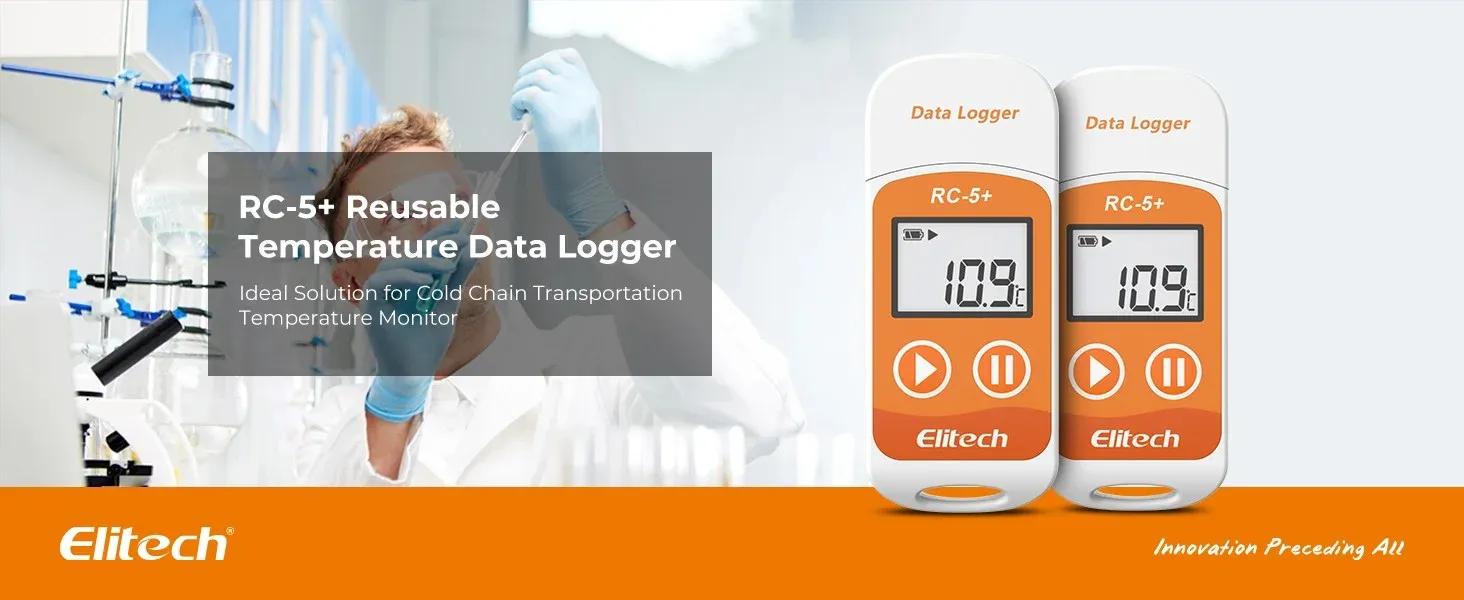
The Elitech range available through Elitechtem UK covers everything from basic single-use transit loggers to professional reusable units with external probe capability. The standout for most UK businesses is the RC-5+ series.
Elitech RC-5+ USB Temperature Data Logger — Key Specifications
- Price: £99.99
- Storage Capacity: 32,000 readings
- Report Format: Automatic PDF and CSV generation
- Connectivity: Plug-and-play USB (no software installation required)
- Accuracy: ±0.5°C
- Temperature Range: -30°C to +70°C
- Recording Intervals: Configurable from 10 seconds to 24 hours
- Reusable: Yes — multiple trip capability
- Calibration: Certificate included
That 32,000-point capacity is significant. At a 1-minute recording interval, that's over 22 days of continuous monitoring. Set it to every 5 minutes and you're looking at 111 days. For most transit and storage applications, that's more than enough between data downloads., a favourite among Britain’s tradespeople
The PDF Auto-Generation Feature
This is where Elitech units genuinely shine compared to cheaper alternatives. You plug the logger into any computer — Windows, Mac, doesn't matter — and it immediately generates a timestamped PDF report. No drivers. No proprietary software. No IT department involvement needed.
For auditors and compliance officers, this is brilliant. The PDF includes min/max/average temperatures, any alarm excursions, and a complete graphical overview. You can also export raw data as CSV for deeper analysis — dead handy if you're building temperature datasets or tracking trends over time.
External Probe Option (RC-5+TE)
The TE variant adds an external temperature sensor on a cable. Why does that matter? Because sometimes you need the logger outside the monitored environment while the probe sits inside. Think: probe inside a sealed vaccine fridge, logger accessible on the outside for easy reading. Spot on for pharmacy applications. (And yes, it's as straightforward to set up as it sounds — no fiddling about.)
Industry Applications for Temperature Data Loggers UK Businesses Rely On

Pharmaceutical and Healthcare
NHS trusts and private pharmacies across the UK must maintain vaccine storage between +2°C and +8°C. That's a tight window. The UK Government's Green Book guidelines specify continuous monitoring with documented evidence. A USB temperature recorder with ±0.5°C accuracy meets these requirements comfortably.
I've visited pharmacies here in Birmingham where they've been using Elitech loggers for over two years without a single unit failure. The pharmacist — a colleague, actually — told me the automatic PDF reports saved her about 30 minutes daily compared to her old manual system. That adds up.
Food Manufacturing and Distribution
HACCP compliance demands documented temperature control at every critical control point. For a food manufacturer running multiple cold rooms, walk-in freezers, and chilled transport, you might need 10–20 loggers running simultaneously. At £99.99 per unit, that's a manageable investment compared to the cost of a failed audit or product recall.
The configurable alarm thresholds are particularly useful here. Set your high alarm at +5°C for chilled goods, and the logger flags any excursion the moment you download data. No scrolling through thousands of readings manually.
Cold Chain Logistics and Transport
UK haulage companies moving temperature-controlled goods need proof that conditions were maintained throughout transit. A compact USB logger placed inside each consignment provides that evidence. The reusable nature of the RC-5+ means drivers can retrieve units at delivery, download data, reset, and redeploy. Sorted.
For businesses tracking daily temperature data across multiple routes, the CSV export function allows easy aggregation into fleet-wide monitoring dashboards.
Laboratory and Research
Research labs, particularly those working to ISO 17025 standards, require calibrated temperature monitoring with full traceability. The included calibration certificate with Elitech units satisfies initial audit requirements, though annual recalibration is recommended for continued compliance.
How to Choose the Right Temperature Data Logger for Your UK Business

Not every operation needs the same device. Here's my honest breakdown of what to prioritise based on your sector.
Decision Factors
Budget per unit: If you're deploying 50+ loggers for transit monitoring, cost per unit matters enormously. Single-use disposable loggers exist for under £10, but they can't be recalibrated or reused. The Elitech RC-5+ at £99.99 pays for itself within 3–4 uses compared to buying disposables repeatedly.
Recording capacity: 32,000 points is the sweet spot for most applications. Some cheaper units offer only 8,000 or 16,000 — fine for short transits, but limiting for extended storage monitoring.
Accuracy requirements: Pharmaceutical applications demand ±0.5°C minimum. Food storage can sometimes tolerate ±1°C. Don't overspend on laboratory-grade ±0.1°C accuracy if your application doesn't require it.
Environmental rating: Will the logger be exposed to moisture? Condensation in cold rooms is real. Check the IP rating. Most USB loggers aren't fully waterproof — the USB port needs protection. External probe models solve this by keeping electronics outside the harsh environment., popular across England
What I'd Recommend
For most UK businesses starting with temperature monitoring, the Elitech RC-5+ is the sensible choice. It covers the widest range of applications, the price is fair, and the plug-and-play USB means zero training time for staff. My experience with cheaper alternatives? They work initially, then drift out of calibration within months. That said, if you're only doing single-trip monitoring for exports, a disposable unit might genuinely be more practical.
Worth the extra spend on the TE external probe version? Absolutely, if you're monitoring sealed environments. The flexibility is proper useful.
Frequently Asked Questions
How accurate are Elitech temperature data loggers for UK pharmaceutical use?
Elitech RC-5+ loggers offer ±0.5°C accuracy, which meets MHRA GDP guidelines for pharmaceutical cold chain monitoring in the UK. Each unit ships with a calibration certificate. The -30°C to +70°C range covers all standard vaccine and medication storage requirements, including frozen biologics and ambient-stored pharmaceuticals.
Do USB temperature loggers need special software to work?
No. The Elitech RC-5+ generates PDF and CSV reports automatically when plugged into any USB port — Windows or Mac. No drivers, no software installation, no IT support needed. The device appears as a standard USB drive containing your timestamped temperature report ready for immediate use or archiving.
How long can a 32,000-point data logger record continuously?
Recording duration depends on your chosen interval. At 1-minute intervals, 32,000 points provides 22 days of continuous monitoring. At 5-minute intervals, that extends to approximately 111 days. At 15-minute intervals, you'll get over 333 days — nearly a full year of uninterrupted temperature data from a single deployment.
Are temperature data loggers UK-compliant for HACCP food safety?
Yes. USB temperature data loggers with ±0.5°C accuracy and timestamped reporting satisfy HACCP documentation requirements for UK food businesses. The automatic PDF generation provides the audit trail environmental health officers expect during inspections. Ensure your logger includes a valid calibration certificate and schedule annual recalibration.
What's the difference between the Elitech RC-5+ and RC-5+TE?
The RC-5+ uses an internal sensor measuring ambient temperature around the device itself. The RC-5+TE adds an external probe on a cable, allowing you to place the sensor inside sealed environments — fridges, containers, or packaging — while keeping the logger body accessible outside. Both store 32,000 readings and auto-generate PDF/CSV reports at £99.99.
How often should temperature data loggers be recalibrated?
Industry best practice recommends annual recalibration for reusable temperature data loggers. Pharmaceutical applications under MHRA guidelines typically require 12-month calibration cycles. The Elitech RC-5+ includes an initial calibration certificate. For ongoing temperature data management, tracking calibration dates alongside your monitoring records ensures continuous compliance.
Key Takeaways
- Temperature data loggers UK businesses need must offer ±0.5°C accuracy minimum — this satisfies pharmaceutical, food safety, and cold chain compliance requirements across all major regulatory frameworks.
- USB plug-and-play connectivity eliminates software dependencies — the Elitech RC-5+ generates instant PDF/CSV reports on any computer without installation, saving significant staff time.
- 32,000-point storage capacity provides 22 to 333+ days of monitoring depending on recording interval, covering virtually all transit and storage scenarios.
- At £99.99 per unit, reusable USB loggers offer better long-term value than disposable alternatives or subscription-based cloud systems for most UK operations.
- Automatic alarm threshold reporting catches temperature excursions that manual twice-daily checks would miss entirely — critical for overnight and weekend monitoring.
- External probe variants (RC-5+TE) solve the sealed-environment challenge — essential for pharmacy fridges, sealed containers, and any application where the logger can't sit inside the monitored space.
- Annual recalibration maintains compliance — initial calibration certificates are included, but budget for yearly verification to satisfy auditors in 2026 and beyond.
Getting Started with Temperature Monitoring
Alright? Look, I know choosing monitoring equipment isn't exactly thrilling. But getting it right saves you money, protects your stock, and keeps auditors happy. That's a decent return on a few minutes of research.
The market for temperature data loggers UK suppliers offer ranges from £10 disposables to £500+ connected systems. For the vast majority of businesses I've worked with around Birmingham and across the Midlands, the sweet spot sits right where the Elitech RC-5+ lands — professional-grade accuracy, genuinely zero-hassle data retrieval, and a price that doesn't require board approval. (Honestly, I've recommended these to people who were braced for a much bigger spend and were pleasantly surprised.)
If you're still using manual temperature checks or struggling with unreliable wireless systems that drop connection in your cold room, switching to USB monitoring is the most practical upgrade you can make this year. Visit Elitechtem UK to see the full range and get proper specifications for your specific application.
Bang for your buck, it's hard to beat.
Ready to upgrade your compliance with {brand_name}?
Explore Solutions — £45.47